What Is a Private AI Assistant?
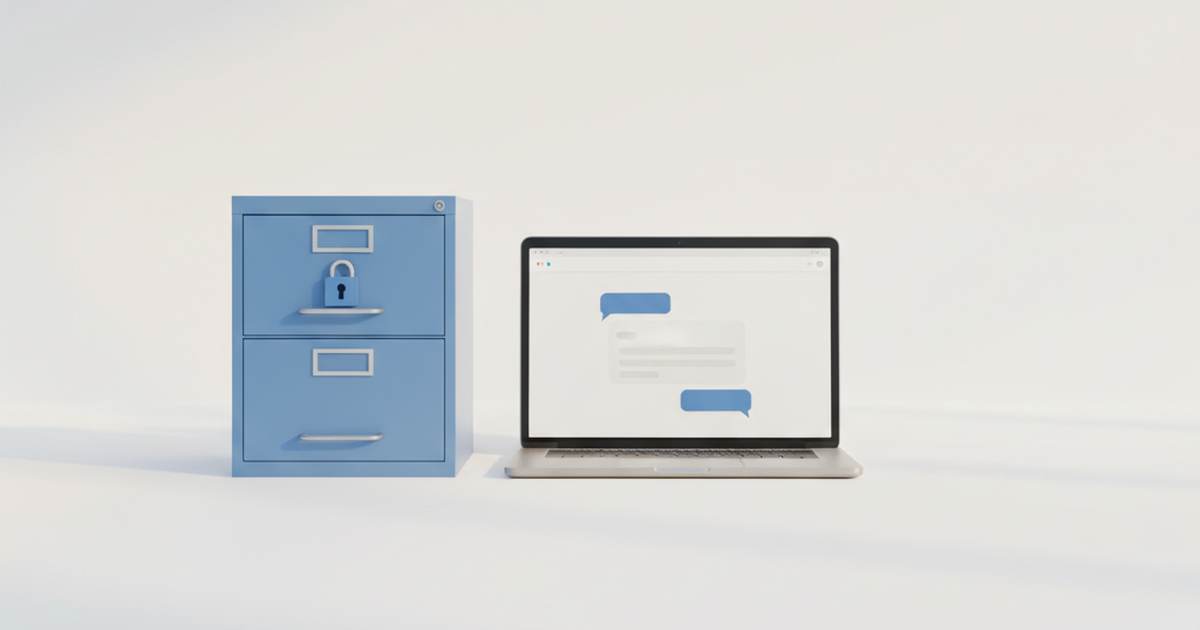
A private AI assistant is an AI tool built so your data stays yours. It does not use your conversations to train shared models, it does not pool your information with other customers, and it can run on infrastructure you control. The work is the same as any AI assistant. The difference is who can see what you put in.
TL;DR: A private AI assistant keeps your inputs out of shared training data, out of a common cloud pool, and optionally on your own server. This matters because 64% of organizations now worry about inadvertently exposing sensitive information through generative AI, according to Cisco's 2025 Data Privacy Benchmark Study. The label is less important than three guarantees: your data is not used for training, not shared, and you can see where it lives.
A private AI assistant answers email, drafts replies, runs research, and prepares briefings like any other assistant. What makes it private is the data contract underneath. Public consumer tools often reserve the right to use your inputs to improve their models, store your conversations on shared infrastructure, and route everything through one common cloud. A private assistant removes those defaults. Your business information is treated as yours, not as raw material.
How is a private AI assistant different from a public one?
A private AI assistant differs from a public one on three points: your data is not used for model training, it is not pooled with other customers' data, and it can run on a server you own rather than a shared cloud. Public tools usually default to the opposite. The function looks identical from the outside, but the privacy posture is the real distinction, and for a business owner it is the one that matters.
Think of it as three separate questions you should be able to answer "no" to with a private tool:
- Training: Is my data used to train models that other people will use? With a private assistant, no.
- Pooling: Is my information stored in a shared pool alongside other companies' data? With a private assistant, no.
- Location: Do I know where my data physically lives, and can I keep it on my own infrastructure? With a private assistant, yes, you can.
The concern is not theoretical. In Cisco's 2024 Data Privacy Benchmark Study, 48% of respondents admitted entering non-public company information into generative AI tools, and 45% had entered employee information. Most of that data went into public consumer products with broad data-use terms. A private assistant is the structural answer to that habit: it lets people do the work without the leak.
What do owners risk with public AI tools?
The main risk is that confidential business information leaves your control the moment it is typed into a public tool. Customer details, contracts, financials, and unreleased plans can be stored on shared servers, used to improve models, or exposed in a breach. Cyberhaven Labs found that 71.7% of AI tools used at work carry a high or critical data-security risk, measured across the real usage of 7 million workers in 2025.
The exposure compounds in two ways. First, sensitive data is flowing in faster every year: 34.8% of the corporate data put into AI tools in 2025 was sensitive, up from 27.4% the year before and 10.7% two years earlier. Second, much of this happens quietly, outside official channels, which is why it is often called shadow AI.
That gap shows up in breach data. IBM's Cost of a Data Breach Report 2025 put the global average cost of a breach at $4.44 million, and found that shadow AI was a factor in roughly one in five breaches, adding about $670,000 to the average cost when it was involved. The report also noted that 97% of organizations that suffered an AI-related breach lacked proper AI access controls. A private assistant does not erase every risk, but it removes the most common one: data going somewhere you never agreed to.
How does a self-hosted private AI assistant work?
A self-hosted private AI assistant runs on a server you own or control rather than on a vendor's shared cloud. Your data stays inside your own environment, the assistant connects to your inbox and tools from there, and nothing is pooled with other customers. This is the strongest form of private, because privacy is enforced by where the system physically runs, not only by a policy promise.
There is a spectrum here. A managed-private assistant runs on dedicated infrastructure a provider operates for you, with contractual guarantees that your data is not trained on or shared. A self-hosted assistant goes further: the software runs on hardware you control. Both are private in the sense that matters most for daily work. The trade-off is usually control versus convenience, which is worth weighing directly in self-hosted vs managed-private AI assistant.
The trend is moving toward this kind of control. Gartner predicts that by 2027, 35% of countries will be locked into region-specific AI platforms using proprietary, in-region data, up from around 5% today, driven by data-sovereignty and regulatory pressure. The same logic that pushes nations toward sovereign AI pushes owners toward private assistants: keep the data where you can answer for it.
Raegan takes the self-hosted route. It is built on Hermes, an open-source agent from Nous Research, and runs on the customer's own server so business data is never sold, shared, or dropped into a common cloud pool. The point is to let an owner hand off inbox and research work without handing off the data.
How to evaluate a private AI assistant: a checklist
Evaluate a private AI assistant by asking where your data lives, whether it is used for training, and who else can see it. The right tool gives plain answers, not vague reassurance. Use this checklist before you connect any assistant to your inbox or files:
- Training: Does the provider use my inputs or outputs to train shared models? You want a clear no, in writing.
- Data pooling: Is my data isolated, or pooled with other customers on shared infrastructure?
- Hosting and residency: Can it run on my own server or a dedicated environment, and do I know which region my data sits in?
- Retention and deletion: How long is data kept, and can I delete it on demand?
- Access controls: Who at the provider can see my data, and is there logging? Recall that 97% of AI-related breaches involved missing access controls.
- Open vs closed: Is the underlying model open and inspectable, or a black box? This connects to open-source AI assistants explained.
- Outbound control: Does anything customer-facing send automatically, or is there an approval step you control?
If a vendor cannot answer the first three quickly, treat the tool as public regardless of how it markets itself. For the broader safety question behind this checklist, see are AI assistants safe? data privacy for owners. And if you are weighing a private assistant against a general-purpose one, the wider category is covered in AI personal assistant.
Frequently asked questions
Is a private AI assistant the same as a self-hosted one?
Not exactly. Self-hosted is one form of private, where the assistant runs on hardware you control. A private assistant can also be managed-private, running on dedicated infrastructure a provider operates with contractual guarantees that your data is not trained on or shared. Self-hosting offers the most control; managed-private trades some control for convenience.
Does a private AI assistant use my data to train its model?
A properly private assistant does not use your inputs or outputs to train shared models. That is one of the core promises that separates it from public consumer tools, which often reserve that right by default. Always confirm this in writing before connecting it to sensitive data, since the term "private" is used loosely across the market.
Why not just use a public AI tool carefully?
Careful use still leaks. Cyberhaven found 34.8% of corporate data entered into AI tools in 2025 was sensitive, and IBM linked shadow AI to about one in five breaches. Policies and good intentions do not change a public tool's data terms or storage. A private assistant fixes the problem structurally instead of relying on everyone behaving perfectly.
Is a private AI assistant less capable than a public one?
No. A private assistant can use the same class of capable models to triage email, draft replies, run research, and prepare briefings. The difference is the data contract and where the system runs, not the quality of the work. Open-source models now sit close to leading closed ones for most everyday assistant tasks.
How do I know if an assistant is genuinely private?
Ask three questions: is my data used for training, is it pooled with other customers, and where does it physically live. A genuinely private assistant answers all three clearly and lets you keep data on your own or dedicated infrastructure. If the answers are vague, assume the tool is public regardless of its marketing language.
Sources
- Cisco. "2025 Data Privacy Benchmark Study," 2025. https://newsroom.cisco.com/c/r/newsroom/en/us/a/y2025/m04/cisco-2025-data-privacy-benchmark-study-privacy-landscape-grows-increasingly-complex-in-the-age-of-ai.html
- Cisco. "2024 Data Privacy Benchmark Study," 2024. https://newsroom.cisco.com/c/r/newsroom/en/us/a/y2024/m01/organizations-ban-use-of-generative-ai-over-data-privacy-security-cisco-study.html
- Cyberhaven Labs. "2025 AI Adoption and Risk Report," 2025. https://www.cyberhaven.com/press-releases/cyberhaven-report-majority-of-corporate-ai-tools-present-critical-data-security-risks
- IBM. "Cost of a Data Breach Report 2025," 2025. https://www.ibm.com/reports/data-breach
- Gartner. "Gartner Predicts 35% of Countries Will Be Locked Into Region-Specific AI Platforms by 2027," 2026. https://www.gartner.com/en/newsroom/press-releases/2026-01-29-gartner-predicts-35-percent-of-countries-will-be-locked-into-region-specific-ai-platforms-by-2027
Raegan is a private, self-hosted AI assistant for owners who want the help without giving up their data. Get early access.