How AI Personal Assistants Work
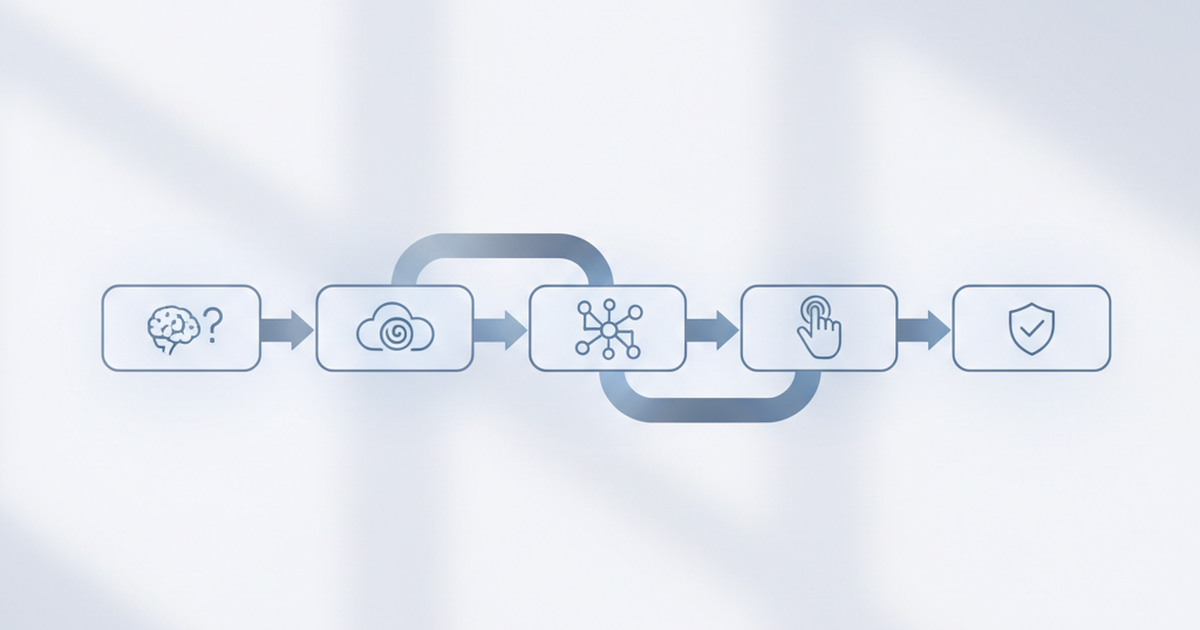
TL;DR: A personal AI assistant works as a pipeline: it understands what you wrote in plain language, pulls in memory and context, connects to your email, calendar, and channels, then takes an action and pauses for your approval before anything customer-facing goes out. The engine is a large language model. McKinsey reported in November 2025 that 72% of organizations now use generative AI, up from 33% in 2024, so most owners already touch the underlying technology even if they have not handed it real work yet.
You type a sentence. A few seconds later your calendar has a new meeting, a draft reply is waiting in your voice, and your day has a short briefing at the top. What happened in between is not magic, and it is worth understanding before you trust one with your inbox. This guide walks through the pipeline plainly, for owners who want to know what they are buying.
If you are new to the category, start with what a personal AI assistant is, then come back here for the mechanics.
How does an AI personal assistant work, step by step?
An AI personal assistant works in five stages: it understands your request in natural language, retrieves memory and context, connects to your tools through APIs, plans and takes an action, then pauses at an approval gate before anything sensitive is sent. The core engine is a large language model, the same kind of system behind ChatGPT and Claude. Everything else is plumbing that lets the model read your real data and act on it instead of only talking.
Think of it less as one clever brain and more as an assembly line. Each stage does a narrow job, and the quality of the whole depends on every link holding. The rest of this guide takes the stages one at a time.
Stage 1: How does it understand what you wrote?
It understands you through a large language model, software trained on enormous amounts of text to predict and generate language. When you type "reschedule my 2pm to Thursday and tell Dana," the model parses the intent, the entities (the meeting, Thursday, Dana), and the implied actions. It does not match keywords against a script the way an old chatbot did. It interprets meaning, which is why you can phrase a request ten different ways and still be understood.
The model reads your words as tokens, small chunks of text, and works within a context window, the amount of text it can consider at once. Modern assistants have large context windows, so they can hold a long conversation, a document, and your instructions together while they reason. For the conversational side of this in more depth, see what a conversational AI assistant is.
Stage 2: How does it remember your business?
It remembers through a mix of stored context and retrieval, not by keeping everything in its head. A language model on its own is stateless: each request starts fresh. To give an assistant memory, the system saves facts about your business and pulls the relevant ones back in when they matter. The common technique is retrieval-augmented generation, or RAG.
RAG works like a research step before the model answers. Anthropic's engineering documentation describes contextual retrieval, where your documents and notes are split into chunks, stored as searchable embeddings, and the most relevant pieces are fetched and handed to the model at the moment of the request. So when you ask the assistant to follow up with a client, it can retrieve that client's history rather than guess. This is the difference between a tool that forgets you between sessions and one that learns your business over time.
Stage 3: How does it connect to your email, calendar, and channels?
It connects through tool use, also called function calling, where the model is given a set of tools it can call to read and write in your real systems. According to Anthropic's tool-use documentation, you provide the model a list of tools, each with a name, description, and input schema. The model decides when a tool can help, then returns a structured request naming the tool and its arguments. Your application runs that request against the real system and hands the result back.
The important detail, straight from the documentation, is that the model does not run the code itself. It only signals intent. When the model wants to check your calendar, it returns a tool_use request; your software actually queries the calendar API and returns the answer. That separation is what lets an assistant book a meeting, read an email thread, or post to Slack, while keeping the action under your system's control rather than the model's.
Stage 4: How does it actually take action, and where is the approval gate?
It takes action by chaining tool calls in a loop, then stops at an approval gate before anything customer-facing is sent. This loop is what people mean by "agentic." You give the assistant an outcome, it plans the steps, calls tools, reads the results, and keeps going until the job is done or it needs your sign-off. Drafting a reply, proposing three meeting times, and updating a note can all happen in one chain.
The approval gate is the safety design that matters most for owners. Reading your data is low-risk; sending an email to a customer is not. A responsible assistant drafts the outbound message and waits for you to approve it before it leaves. That single checkpoint keeps a human in control of anything that reaches a client, which is exactly where you want the line drawn given that these systems are not perfect (more on that below).
Raegan is built around this gate. It is a private, self-hosted personal AI assistant that triages email and drafts replies in your voice, and nothing customer-facing sends without your approval. It is reachable across more than 20 channels like WhatsApp, iMessage, Slack, and Telegram, so the action stage meets you where you already work rather than in a single window.
Stage 5: How does it learn and get better over time?
It learns mainly by accumulating memory about you, not by retraining the underlying model on the fly. Each time you correct a draft, approve a phrasing, or set a preference, the system stores that signal and retrieves it next time through the same RAG mechanism from Stage 2. So the assistant that drafts in your voice this month should draft more like you next month, because it has more examples of what you accept and what you change.
This is worth being precise about, because "learning" gets oversold. The big model behind the assistant is not quietly rewriting itself from your emails. What improves is the context it carries: your tone, your contacts, your recurring tasks, the way you like your briefing. That is a meaningful kind of learning, and it is also why a private, single-tenant setup matters, so your business context is not pooled with anyone else's.
How capable and reliable are these assistants, really?
They are strong on routine work and still imperfect on hard, multi-step tasks. Stanford HAI's 2026 AI Index Report found that AI agents jumped from roughly 12% to 66.3% task success on OSWorld, a benchmark of real computer tasks across operating systems, within about six points of the 72.35% human baseline. That is a large one-year leap, and it still means agents fail close to one in three structured tasks. For an owner, the honest read is: expect reliable help on routine work, and keep the approval gate on anything that matters.
Adoption tells the same two-sided story. The chart below shows how far generative AI has spread into organizations, and how much narrower true agent use still is.
The gap between the blue bars and the bottom green one is the whole point. Most organizations now use AI to talk and draft. Far fewer have handed it the agentic, do-the-work loop from Stage 4. That is the newer wave, and it is why the approval gate is not a nice-to-have but the thing that makes handing over real work sane.
Where do AI personal assistants get things wrong?
They get things wrong in a few predictable places, and knowing them is how you use one safely. The most discussed failure is hallucination: a language model can produce a confident, fluent answer that is simply not true, because it generates plausible text rather than looking facts up by default. Retrieval (Stage 2) reduces this by grounding answers in your real documents, but it does not eliminate it.
The other failure modes are practical. An assistant can misread an ambiguous request, call the wrong tool, or chain a multi-step task and stumble partway, which is exactly what the one-in-three OSWorld failure rate reflects. None of this is a reason to avoid the tools. It is the reason the design keeps you in the loop: route low-risk reading and drafting to the assistant, and keep the approval gate on anything a customer will see. If you are still weighing whether you need this at all, the AI personal assistant vs chatbot comparison sorts out which tier fits your work. For the privacy and control side of running one on your own infrastructure, see the self-hosted AI assistant guide.
FAQ
What technology powers a personal AI assistant?
The core is a large language model, the same class of system behind tools like ChatGPT and Claude. Around it sit three layers: retrieval for memory, tool use (function calling) to connect to your email and calendar, and an approval step for control. The model handles language; the surrounding system handles data, actions, and safety.
Does an AI assistant really remember me, or does it start fresh each time?
It remembers, but not the way a person does. The language model itself is stateless and starts each request fresh. Memory comes from a separate layer that stores facts about your business and retrieves the relevant ones when needed, often using retrieval-augmented generation. That is what lets it recall a client's history or draft in your established voice.
How does an assistant send email or book a meeting without me?
Through tool use. The model is given tools that can read and write to your systems, and it returns a structured request to use one. Your software runs that request against the real API. The model does not execute anything itself, and a responsible assistant pauses at an approval gate so you sign off before customer-facing email is sent.
Can I trust an AI assistant with important work?
For routine work, yes; for high-stakes work, keep a human in the loop. Stanford HAI's 2026 AI Index found agents reached 66.3% task success on the OSWorld benchmark, close to humans but still failing about one in three structured tasks. The practical safeguard is an approval gate, so a person reviews anything customer-facing before it goes out.
What is the difference between a personal AI assistant and ChatGPT?
ChatGPT is a chat interface to a language model: you ask, it answers. A personal AI assistant adds memory of your business and the ability to act across your tools, with approvals. Put simply, ChatGPT mostly talks, while a personal assistant connects to your email, calendar, and channels and gets work done.
Sources
- 88% of organizations regularly use AI in at least one function; 72% use generative AI (up from 33% in 2024); 62% at least experimenting with AI agents, 23% scaling them. McKinsey, "The state of AI in 2025," November 5, 2025. https://www.mckinsey.com/capabilities/quantumblack/our-insights/the-state-of-ai
- AI agents on OSWorld rising from ~12% to 66.3% task success versus a 72.35% human baseline. Stanford HAI, 2026 AI Index Report (Technical Performance), 2026. https://hai.stanford.edu/ai-index/2026-ai-index-report/technical-performance
- How tool use / function calling works: tool definitions, the model returning a structured tool_use request, and the application (not the model) executing it. Anthropic, "Tool use with Claude," Claude API documentation, 2026. https://platform.claude.com/docs/en/agents-and-tools/tool-use/overview
- Retrieval-augmented generation and contextual retrieval: chunking documents, storing embeddings, and fetching relevant context at request time. Anthropic, "Contextual Retrieval in AI Systems," 2024. https://www.anthropic.com/engineering/contextual-retrieval
- 34% of US adults have used ChatGPT (58% of under-30s), about double the 2023 share. Pew Research Center, June 25, 2025. https://www.pewresearch.org/short-reads/2025/06/25/34-of-us-adults-have-used-chatgpt-about-double-the-share-in-2023/
- Raegan positioning: private, self-hosted personal AI assistant, approval-gated email drafted in your voice, 20+ channels. Raegan, 2026. https://raegan.ai
Want an assistant that runs this whole pipeline privately, on your own server, in your voice, with you approving anything customer-facing? Get early access to Raegan.